
The foundation of contemporary corporate expansion is digital marketing, which has completely changed how organisations reach clients, make money, and expand. By 2034, the digital marketing market is expected to reach $1,443.27 billion at a compound annual growth rate (CAGR) of 9.20%. The significant influence that digital marketing has on business success across all industries and organisation sizes is shown in this tremendous increase.
The Revenue Generation Engine
When compared to conventional marketing techniques, digital marketing yields results that are unmatched, with an astounding return on investment (ROI) of $36 for every $1 invested, or 3,600%. Email marketing is the most effective. Email’s remarkable effectiveness is a result of its low cost, ability to target particular audiences, personalise messaging, and sustain long-term customer connections.
With an average return on investment (ROI) of 825% across all sectors, search engine optimisation (SEO) shows equally amazing returns. Businesses usually break even within 7 months and see steady development after that due to the compound nature of SEO results. Organic search traffic has an eight-fold higher conversion rate than outbound marketing leads, with SEO leads closing at a rate of 14.6% as opposed to 1.7%.
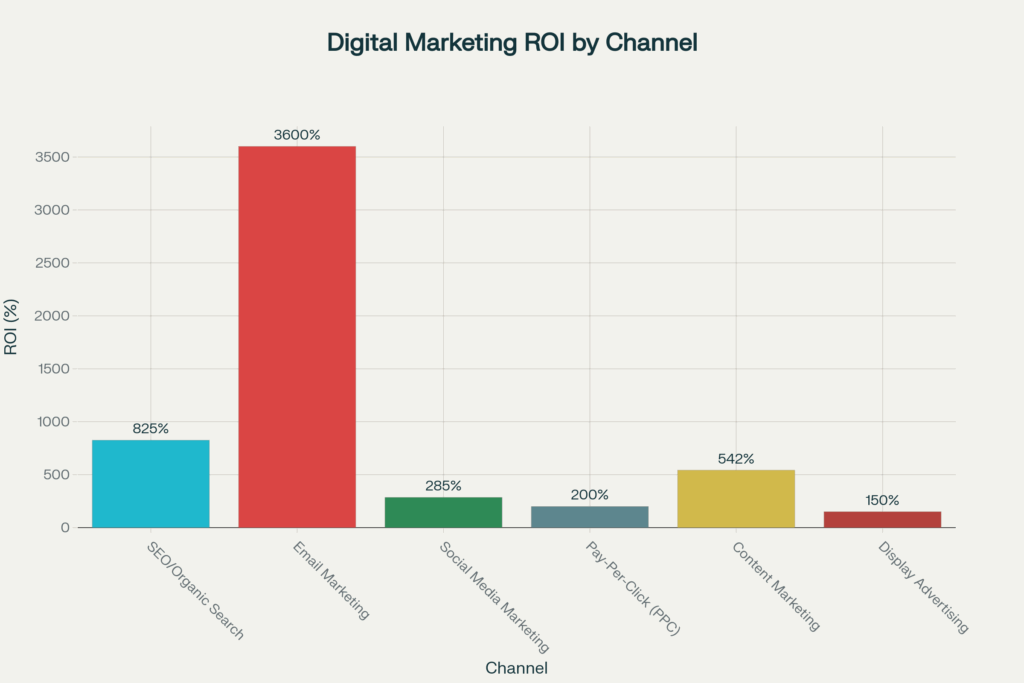
Digital marketing ROI comparison showing email marketing leading with 3600% ROI, followed by SEO at 825% ROI
Even though it requires constant investment, pay-per-click (PPC) advertising offers quantifiable outcomes and instant visibility. On average, businesses make $2 for every $1 spent on Google Ads, with well-optimised ads yielding a return on investment of 200–400%. PPC’s primary benefits are its real-time optimisation and precise targeting features.
Cost-Effective Customer Acquisition
When compared to conventional approaches, digital marketing dramatically lowers client acquisition costs (CAC). At about $12 per client, email marketing has the lowest cost per acquisition (CAC), followed by content marketing at $35 per customer. However, in order to get the same people, traditional advertising approaches frequently cost 61% more than digital channels.
Cost-effectiveness goes beyond procurement to optimise lifetime value. Businesses can increase client lifetime value while keeping ongoing costs low by using digital marketing to cultivate relationships through targeted retargeting campaigns, automated email sequences, and personalised content.
Traffic Dominance and Market Reach
The primary source of online visitors, organic search generates 53% of all website traffic. This traffic share has continuously been high, and estimates indicate that organic search will continue to dominate until 2025. Organic traffic is especially valuable for long-term business success because it is sustainable.
Search engines account for 93% of all internet traffic, highlighting how crucial search visibility is to the success of any organisation. Most of this traffic goes to businesses that rank on the first page, with 54.4% of all clicks going to the first three search results. With 62.54% of organic search traffic coming from mobile devices, mobile search is still driving growth. This change calls for digital marketing strategies that prioritise mobile to effectively reach the expanding mobile audience.
Social Media Impact and Engagement
Social media marketing is now a major source of income, surpassing even brand awareness. In 2023, social media advertising will account for over $230 billion, or 33% of all digital advertising spending. Social media’s power resides in its capacity to promote viral content distribution and direct consumer contact. 81% of marketers claim that video content directly increases sales, while 86% of companies utilise video as a marketing tool. Social media content’s interactive and visual elements increase engagement rates and fortify bonds between brands and consumers. However, since 51% of consumers will unfollow firms that irritate them on social media, social media management is crucial. This figure emphasises the significance of value-driven, strategic content as opposed to merely promotional messaging.
Business Growth Acceleration
67% of marketers measure revenue directly from content marketing leads, and 72% of firms say that content marketing greatly increases lead creation. A sustained funnel is produced by content marketing to draw in qualified leads who are actively looking for answers to their issues. Conversion optimisation is a speciality of digital marketing thanks to its testing capabilities and data-driven insights. Digital marketing attains a lead-to-close rate of 9.9%, which is over six times better than that of traditional marketing techniques, which only manage 1.7%. The ability of digital marketing to target high-intent groups and personalise messaging is responsible for this significant improvement. With automated emails producing 320% more income than non-automated programs, email marketing in particular has remarkable conversion effectiveness. Email is an effective conversion strategy because it combines behavioural triggers, timing optimisation, and personalisation.
Global Market Access and Scalability
Geographical restrictions are removed by digital marketing, giving companies of all sizes access to international markets. By 2025, it is anticipated that over 4.6 billion individuals will use email globally, providing businesses with a huge potential audience. Even tiny businesses may now compete globally because of this global reach, which eliminates the conventional obstacles of distribution networks and physical presence.
Industry-Specific Growth Patterns
The impact of digital marketing varies by industry, with certain sectors experiencing more rapid growth. Due to rising internet usage and mobile-first customer behaviour, the digital marketing sector in India is expected to expand at a 30.2% CAGR between 2024 and 2032.
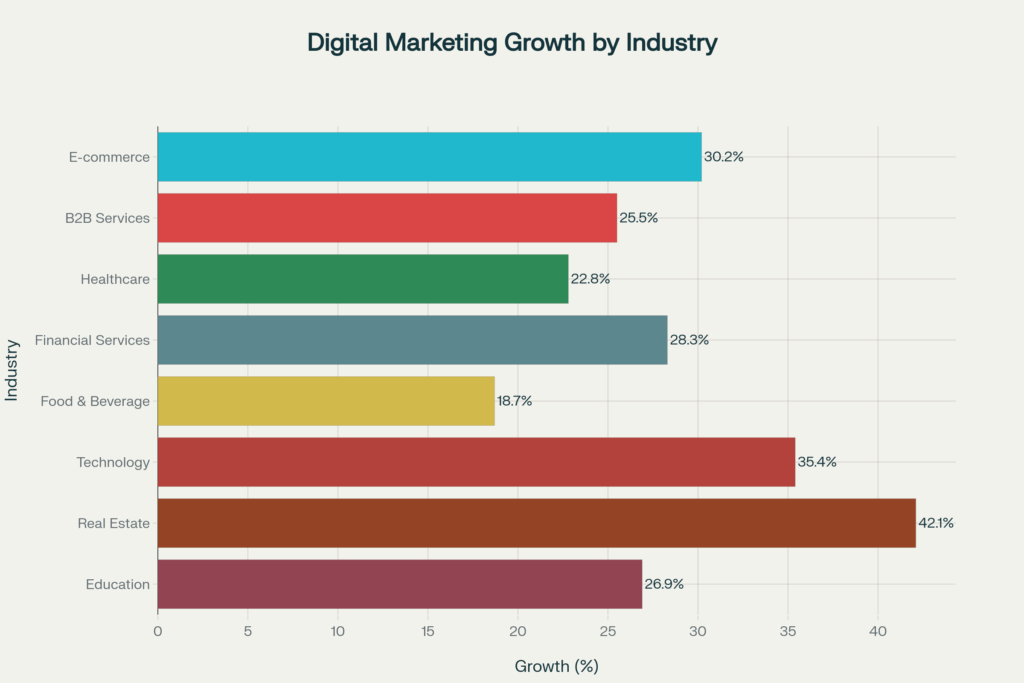
Industry-specific digital marketing growth is showing Real Estate leading at 42.1%, followed by Technology at 35.4%
Conclusion
A major change in how companies expand and compete in the contemporary economy is represented by digital marketing. Businesses that don’t adopt digital marketing run the risk of falling behind, since the global market is expected to reach $1,443.27 billion by 2034. Digital marketing is a crucial part of every company’s growth plan because of its remarkable return on investment, cost-effective customer acquisition, worldwide reach, and ongoing optimisation possibilities. The overwhelming body of evidence shows that digital marketing propels business growth in a number of ways, including producing high-quality leads at reduced costs, establishing brand authority and trust, opening up international markets, and producing quantifiable outcomes that support ongoing development. Businesses must give digital marketing top priority if they want to be competitive and see long-term growth in the changing marketplace as consumer behaviour continues to shift towards digital channels.